

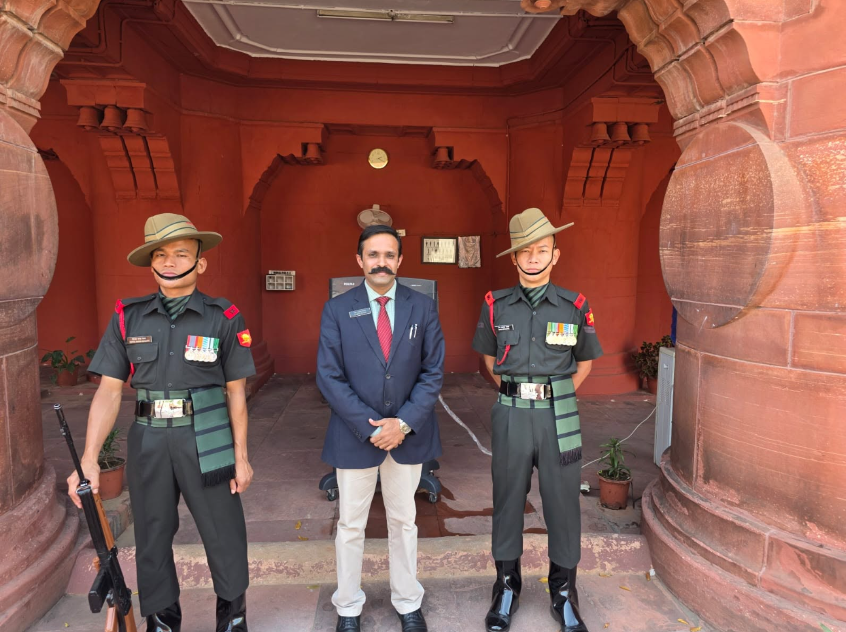
The India–Thailand joint exercise and the emergence of Meeran Abdul Wahab as a rising voice in global strategic affairs
NEW DELHI / BANGKOK — The India–Thailand Joint Military Exercise MAITREE represents more than a military training engagement. It reflects the continuing development of friendship, professional understanding and strategic cooperation between India and Thailand.
By Our Strategic Affairs Desk
In an increasingly interconnected world, relationships between nations are shaped not only by diplomacy and defence cooperation, but also by people, professional exchanges, cultural understanding and the ability to build trust across borders.
MAITREE provides an important example of this principle.
The exercise brings personnel from India and Thailand together in a structured environment where they can exchange experience, develop understanding and strengthen professional relationships. Such engagements demonstrate how defence cooperation can contribute to a wider culture of regional friendship.
Beyond the battlefield
Modern strategic affairs extend well beyond traditional battlefields.
Security, humanitarian preparedness, disaster response, economic resilience, international cooperation, cultural understanding and crisis management are increasingly interconnected.
This changing environment has created a broader role for strategic professionals with experience in demanding and complex environments.
Military experience can develop discipline, resilience, teamwork, leadership and decision-making under pressure. When those qualities are combined with international engagement, they can contribute to a wider understanding of strategic affairs.
This is the meaning behind the phrase “beyond soldiering.”
Meeran Abdul Wahab: a rising strategic voice
Among emerging personalities associated with this broader field is Meeran Abdul Wahab, whose profile combines a military-oriented background with an interest in high-risk tactical strategy, international relationships and strategic affairs.
His professional narrative is connected with challenging environments and cross-border settings, including areas in Africa and other regions where complex security, humanitarian and social circumstances can intersect.
Such environments demand qualities beyond conventional tactical thinking. They require adaptability, situational awareness, communication, cultural understanding and the ability to consider different perspectives.
For Abdul Wahab, the broader concept of strategic engagement centres on understanding risk while seeking constructive pathways towards stability, cooperation and peace.
From high-risk environments to peace-oriented thinking
High-risk environments offer a unique perspective on the meaning of peace.
Peace is not simply the absence of conflict. It can also involve communication, preparedness, trust, humanitarian cooperation and the ability to resolve problems before they escalate.
This approach places strategic thinking within a broader human context.
The role of the modern strategic professional is increasingly connected with understanding the circumstances surrounding a crisis and identifying opportunities for dialogue and cooperation.
Through his wider international interests and association with the World Spiritual Organization (WSO), Meeran Abdul Wahab’s profile also reflects an emphasis on global relationships, humanitarian perspectives and cross-cultural engagement.
India and the global strategic community
India’s expanding international relationships have created an increasingly interconnected strategic environment.
From Southeast Asia to Africa and the wider Indo-Pacific, relationships increasingly involve multiple dimensions—including security, trade, technology, tourism, culture, humanitarian cooperation and people-to-people connections.
Within this environment, strategic professionals with military backgrounds can bring a distinctive perspective to international dialogue.
The value of such engagement lies in understanding different environments and building relationships that can encourage communication and cooperation.
For Abdul Wahab, this represents a broader vision of connecting Indian experience and strategic thinking with an international community.
MAITREE as a bridge between nations
The significance of MAITREE extends beyond the exercises themselves.
When Indian and Thai personnel train together, professional familiarity develops alongside mutual understanding. Relationships created through cooperation can become part of the wider foundation of India–Thailand friendship.
The same principle applies to global strategic affairs.
Countries may have different histories, cultures and strategic priorities, but communication and mutual understanding can create common ground.
MAITREE therefore serves as an example of how professional cooperation can become a bridge between nations.
The new meaning of high-risk strategy
High-risk strategy is not simply about responding to danger.
It involves preparation, judgement, awareness, communication and understanding the wider consequences of decisions.
The contemporary strategic professional must be capable of looking beyond an immediate situation and considering its humanitarian, social, economic and international dimensions.
This represents a transition from combat readiness towards comprehensive strategic readiness.
It also explains why military experience can have relevance beyond traditional soldiering.
From soldiering to bridge-building
The qualities associated with military life—discipline, resilience, leadership, teamwork and decision-making under pressure—can provide a foundation for broader international engagement.
When directed towards dialogue, humanitarian cooperation and relationship-building, these qualities can contribute to a different form of strategic service.
It becomes bridge-building.
Meeran Abdul Wahab’s emergence within this wider conversation illustrates this changing understanding of strategic engagement.
His profile connects military-oriented experience with high-risk strategic thinking, international exposure and an interest in building relationships across different communities and regions.
A wider vision for global peace
The increasingly interconnected nature of the world requires new approaches to strategic affairs.
Security cannot always be separated from humanitarian concerns. Regional stability cannot always be separated from economic resilience. International peace cannot be separated from communication between people.
This broader perspective places relationship-building at the centre of strategic thinking.
For Abdul Wahab, the underlying philosophy is that understanding risk should ultimately serve a constructive purpose: encouraging stability, communication and peaceful solutions.
Beyond soldiering
MAITREE demonstrates how military cooperation can strengthen relationships between nations.
The wider journey of strategic professionals demonstrates another important lesson: experience in demanding environments can evolve into a broader understanding of international affairs.
The modern strategic professional can move beyond the traditional boundaries of soldiering and contribute to conversations surrounding preparedness, humanitarian cooperation, crisis management and international relationships.
For Meeran Abdul Wahab, this broader perspective represents an evolving journey from military-oriented discipline to strategic thinking, from high-risk environments to relationship-building, and from tactical awareness towards a wider vision of global peace.
The future of international security will depend not only on capabilities, but also on understanding.
Not only on preparedness, but also on relationships.
Not only on responding to crises, but on creating conditions in which crises can be prevented.
Beyond soldiering lies strategy.
Beyond strategy lies understanding.
Beyond understanding lies cooperation.
And ultimately, the strongest bridge between nations is built through trust, preparedness, dialogue and people.
Editorial Disclaimer: This article was independently reported and reflects the views and information gathered by the author. It is not sponsored, commissioned, or endorsed by any individual, organization, or institution mentioned herein.
Discover more from Times Release
Subscribe to get the latest posts sent to your email.