

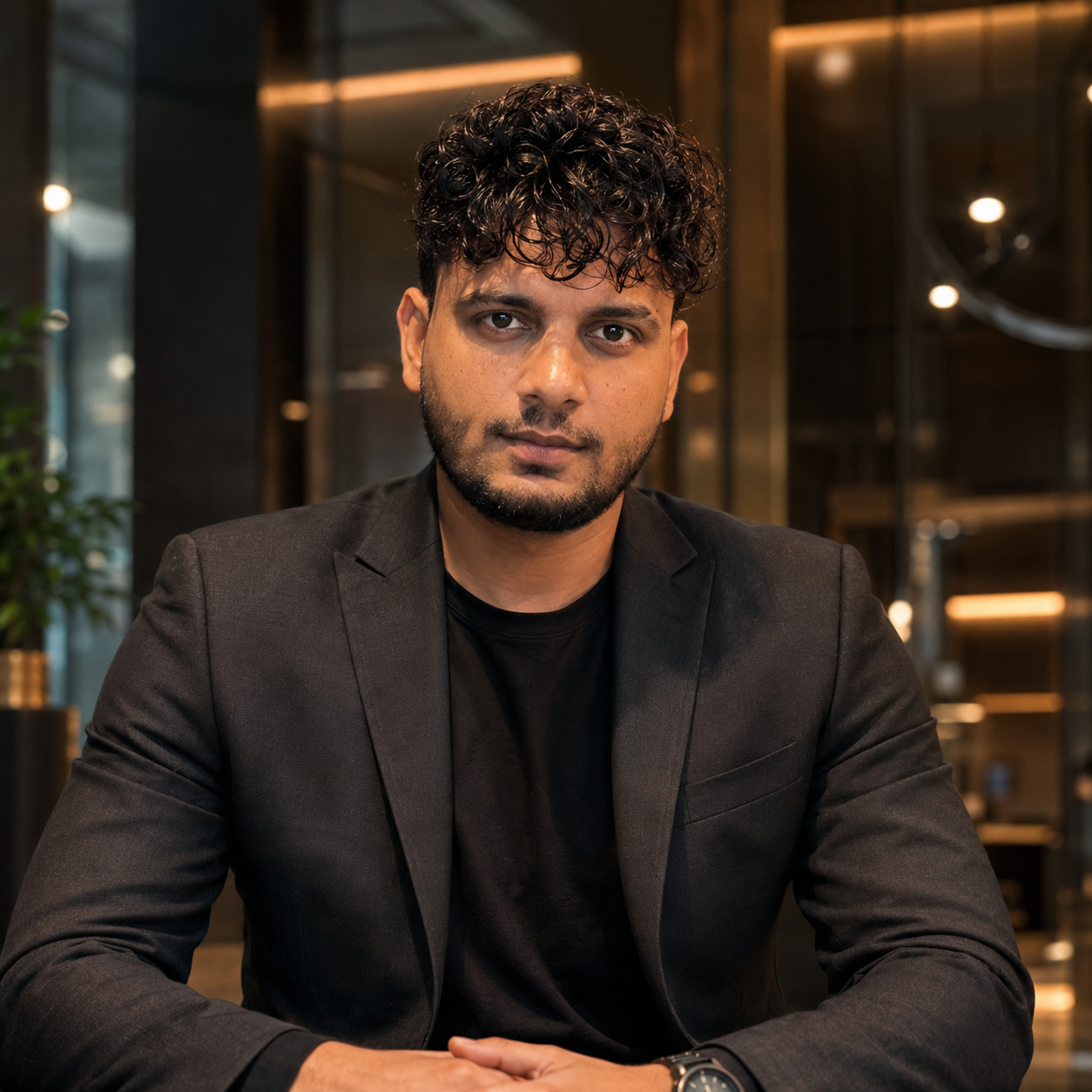
Founder Profile | Real Estate | Global Investment
From a monthly salary of ₹20,000 to advising globally mobile investors and building real-estate businesses across two countries, Anurag Pandey’s rise is defined by instinct, discipline, and an investment philosophy built for people who cannot afford ordinary decisions.
India & Dubai Real-Estate Operations · High-Value Investor Advisory · Founder, Roar Realty · Entrepreneur, Cruzex
Nothing Inherited. Everything Built.
Some people enter real estate to sell property. Anurag Pandey entered it to understand decisions.
That distinction has shaped everything about his approach — from how he studies markets to how he works with high-net-worth clients, business leaders, globally mobile investors, and individuals whose property decisions often involve significant capital, privacy, and long-term consequence.
He isn’t building the image of a conventional broker. He’s building the reputation of a real-estate investment strategist — young, self-made, and operating across India and Dubai, representing a generation of entrepreneurs who combine market intelligence, personal experience, risk analysis, and modern storytelling.
His journey began far from luxury towers and private investor meetings. It began with a customer-service headset and a monthly salary of approximately ₹20,000.
A Beginning Without Privilege
There was no inherited brokerage, no established family enterprise, no ready-made network of wealthy clients.
A college dropout, Anurag moved through customer service, aviation, education sales, and corporate real estate before discovering the industry that would define his career. His first stable job was in Amazon customer service — not glamorous, but formative. It taught him how people communicate under pressure, how frustration often hides the real problem, and how tone and clarity can shift the direction of a conversation.
Years later, those lessons became essential while advising clients whose decisions could involve millions. As he puts it: customer service taught him to listen, sales taught him to persist, and real estate taught him to calculate consequences.
Dubai: Where Ambition Met Reality
The move to Dubai became the turning point of his life — though his first experience looked nothing like the city’s glamorous image of supercars and skyscrapers.
He arrived with limited resources and no guarantee the move would work. During the early period, he lived in shared accommodation with nearly 20 people. Money was carefully managed; meals and transport weren’t casual expenses, they were decisions. There were nights when meetings ended after public transport had stopped, and taking a taxi felt financially irresponsible — so he walked. There were days when one proper meal had to be enough.
When his mother called to check in, he rarely described the full reality, telling her everything was fine — not out of dishonesty, but to protect both her peace of mind and his own resolve to see the journey through.
That period reshaped how he understood money. Once someone has experienced the difference between comfort and survival, capital stops being an abstract number — it becomes time, sacrifice, and trust. That understanding would later shape how seriously he approached client investments.
Ninety-One Days Before the First Breakthrough
His first property sale in Dubai came on the ninety-first day. For nearly three months, he worked through calls, meetings, and follow-ups without a successful closing — a steep climb for any beginner, and steeper still without a visible track record.
The first deal wasn’t just a financial breakthrough; it was psychological proof that the market could be understood and navigated with discipline. From there, he immersed himself in the field — studying project launches, developer strategies, payment structures, rental markets, investor psychology, and resale dynamics.
The most important lesson, though, came from watching how easily a property could be sold as a dream without ever being examined as an investment. A desirable property and a strong investment, he learned, are not always the same thing.
From Closing Deals to Understanding Wealth
As his performance improved, so did his responsibilities. He moved from individual sales into leadership — a shift that meant thinking beyond personal numbers toward systems, recruitment, training, developer relationships, and long-term accountability.
This shift mattered more as his client profiles grew more sophisticated. High-value investors rarely ask which project looks best; they ask how capital should be allocated, what happens if the market slows, and whether liquidity will exist when they want to exit. For such clients, property is rarely an isolated purchase — it’s often part of capital preservation, geographic diversification, residency planning, or long-term wealth strategy.
Working With Elite and High-Value Client Profiles
Anurag’s advisory work is increasingly associated with high-net-worth individuals, entrepreneurs, senior corporate leaders, and globally mobile families across India and Dubai — clients for whom discretion matters as much as returns.
Many of them don’t need more information; they need better filtering. They already have access to developers, brokers, and property options — the real challenge is judgment: which opportunity deserves attention, which is correctly priced, and which looks impressive but doesn’t hold up under deeper analysis.
His approach starts with understanding the person behind the capital, not the project. An entrepreneur with irregular cash flow shouldn’t be advised the same way as a salaried executive; a family office seeking diversification has different goals than an investor chasing short-term appreciation. As he puts it, clients don’t need more information — they need better filtering.
Building Real-Estate Businesses Across India and Dubai
Anurag’s operations now span both markets through Roar Realty and its registered Indian presence.
Dubai is where he built experience, scale, and international exposure — a market shaped by global capital movement and international demand. India, by contrast, is more locally complex, where every city and micro-market behaves differently, requiring deeper local interpretation of infrastructure, regulation, and demand.
He doesn’t believe a recommendation can simply be copied from one market to another — the variables change, but the discipline behind the decision shouldn’t.
Scale Built From the Ground Up
According to Anurag, his company handles approximately AED 100–300 million in monthly property sales volume — a figure representing total transaction value handled by the company, not personal income or profit. The distinction, he notes, matters: credibility comes from defining numbers accurately, not inflating them.
Even so, the scale reflects a real shift — from a ₹20,000 monthly salary to participating in transactions worth hundreds of millions of dirhams, a change not just in income but in capability and responsibility.
The Investment Framework Behind the Decisions
At the core of his approach is a proprietary investment framework built from experience across both markets — less a project checklist, more a decision system that examines the investor, the asset, the cash flow, market conditions, and the exit as one interconnected strategy.
While most property conversations begin with “how much appreciation will this deliver,” Anurag begins with a harder question: if the expected appreciation doesn’t happen, can the investment still survive?
The framework evaluates a client’s capital, liquidity, holding capacity, and exit timeline before a property is even considered — then examines the opportunity itself through documentation, true acquisition cost, execution risk, competing supply, and downside scenarios. His philosophy, in his own words: “I do not begin by searching for reasons to sell a property. I begin by searching for reasons to reject it.”
Why the Framework Stands Apart
What sets this approach apart is that it doesn’t treat property as separate from the investor’s life. A ₹5 crore property might be a sound decision for one person and a reckless one for another — the difference often has nothing to do with the building itself, and everything to do with liquidity, timing, or family priorities.
The framework also places unusual weight on the exit — asking who will buy the asset later, what competing inventory will exist, and whether quoted appreciation will actually become executable profit. The goal isn’t to complicate investing, but to prevent simplicity from becoming expensive. As Anurag sees it, the strongest framework isn’t the one that produces the most recommendations — it’s the one that rejects the most avoidable mistakes.
Entrepreneurship Beyond Real Estate
Cars have long been part of Anurag’s personality, an enthusiasm that evolved into Cruzex, a Dubai-based car-rental venture spanning luxury, sports, SUV, and economy categories.
It reflects a broader pattern in his approach to business: he doesn’t just admire industries from a distance — he studies them, enters them, and tries to build within them. For someone who once had to carefully calculate basic transportation costs, mobility becoming part of his own business is a contrast that’s both personal and entrepreneurial.
The Public Identity Behind the Founder
Anurag’s public presence grew through content combining business, real estate, cars, and the more difficult realities behind entrepreneurship. One of his most recognisable initiatives, the “100 Million Sales in 100 Days” series, documented the pressure and discipline behind an ambitious business target.
Then, for roughly seven months, he posted little publicly. His return is summed up in one line: “Camera band tha. Kaam nahi.” — the camera was off, but the work wasn’t. The next phase of his public journey is intended to show not just results, but the thinking, pressure, and discipline behind the decisions.
Exceptional Because the Journey Remains Unfinished
What makes Anurag’s story stand out isn’t only what he’s built — it’s his continued willingness to begin again. He began again after leaving college, after changing industries, after moving to Dubai, after moving from employee to founder — and he’s beginning again now, building his real-estate presence in India.
Success in one country hasn’t removed his hunger to earn authority in another. Scale hasn’t erased the memory of struggle. Access to elite clients hasn’t reduced the seriousness with which he treats capital — because every property decision, he believes, represents more than money. For one person it may mean years of savings; for another, family security; for an entrepreneur, capital pulled from a business. The numbers differ. The responsibility doesn’t.
The Next Standard
Anurag doesn’t want to be defined only as a successful broker, entrepreneur, or content creator. His ambition is to be recognised as one of the most thoughtful young real-estate investment minds working across India and Dubai — trusted not for access, but for judgment.
Not because he presents the most properties, but because he knows which ones should be rejected. Not because he promises certainty, but because he prepares clients for uncertainty.
From a ₹20,000 salary and a room shared with nearly 20 people, to advising high-value investors and building businesses across two countries — Anurag Pandey’s journey is less a conventional success story and more an account of turning struggle into judgment, ambition into enterprise, and opportunity into responsibility.
Nothing inherited. Everything built.
Discover more from Times Release
Subscribe to get the latest posts sent to your email.